Logo
Home
Archive
Log in
Get the next issue
Logo
  • Home
  • Posts
  • A Family Affair: Klimt’s Close and Personal Connection to a Wealthy Brood
14 OCTOBER 2026

A Family Affair: Klimt’s Close and Personal Connection to a Wealthy Brood

 
There are certain artists that even if they have a large body of work can become known for one singular piece. For example, Edvard Munch has The Scream and Grant Wood has American Gothic. You could even lump Leonardo da Vinci into this group with the Mona Lisa.
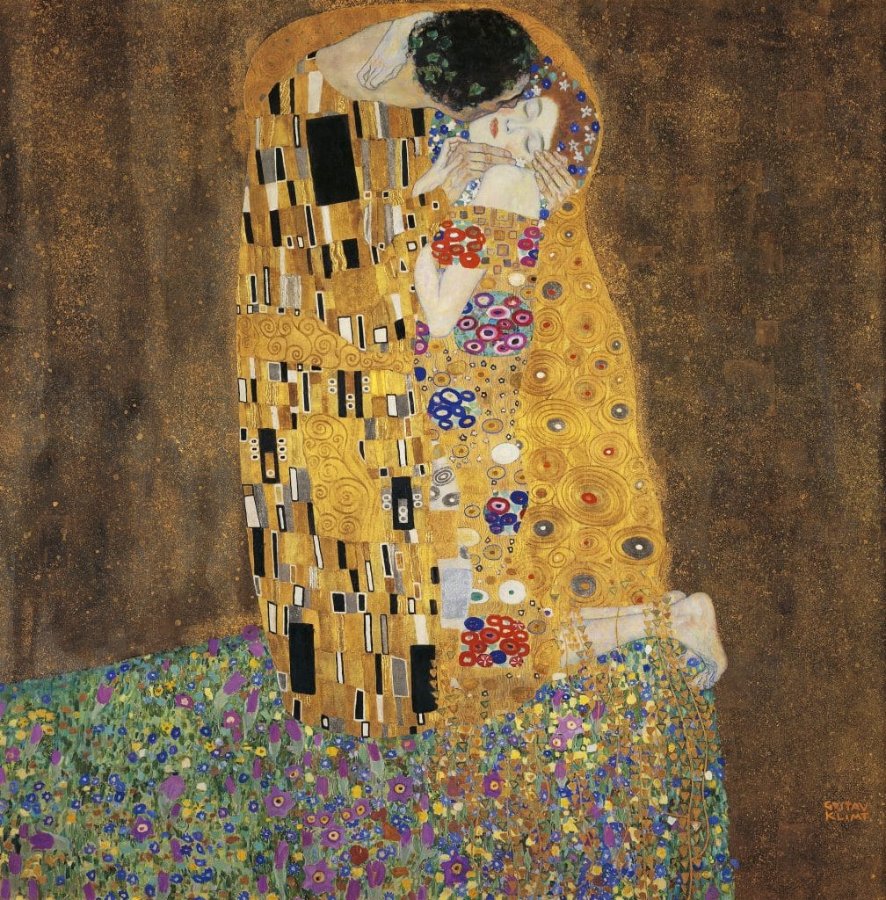
Gustav Klimt is another one who belongs on this list. While he produced over 200 paintings in his lifetime, the work below is probably the only one of his that most people know. The Kiss is instantly identifiable, as it’s one of those catalog staples that’s been printed on everything and anything. The painting has also been parodied extensively, and you can find versions with cats, dogs, and even the Muppets.
We’re not talking about The Kiss today, however. While it has an interesting story, we’re instead going to discuss other paintings of his and how they involve an ultra-rich family, the Nazis, and a life-saving lie.
Painting of a couple wrapped in a gold patterned robe, the man kissing the woman's cheek, kneeling on a flowered meadow against a brown background
Gustav Klimt, a golden embracing couple
Source: thehistoryofart.org

Like Mother, Like Daughter (and Grandmother)

Like many artists of the time, Klimt relied on wealthy patrons to stay flush with brushes and canvases, (not to mention cat food; apparently he had a lot of them). At the top of his patron list were August and Serena Lederer. Thanks to their huge distillery business, at one point they were the second-richest family in Vienna. They were also art collectors, and they commissioned several works from Klimt.
In 1899, Klimt was asked to paint Serena, who was considered a society grande dame and widely known for her beauty and opulent wardrobe. Thrilled with the result of the nearly life-size portrait, the two began a relationship that would last until Klimt’s death in 1918. (When he died, Serena proceeded to buy up all of the work in his estate, giving the Lederers the largest collection of his art in the world.)
Painting of a standing woman with dark upswept hair in a long, pale white gown, set against a soft gray and pink background
Gustav Klimt, Serena Lederer in white
Source: news.artnet.com
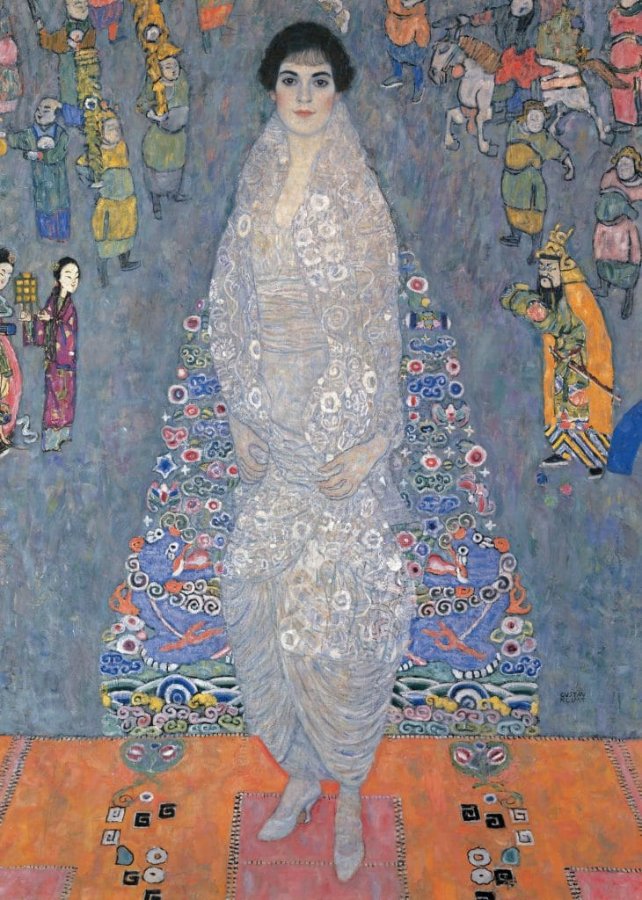
Fifteen years after Klimt painted Serena, he was tasked with painting her 20-year-old daughter. Completed in 1916, Portrait of Elisabeth Lederer shows her in a similar pose as in her mother’s portrait, and they do share a strong resemblance. But instead of the all-white gown mom wears, daughter is in a much more ornate and colorful outfit, and it may even contain a hidden message.
“If you look closely at the sitter’s robe, you’ll see two light blue dragons emerging from crested waves,” said Kirsten Appleyard, a curatorial assistant at the National Gallery of Canada. “What this tells us, along with a number of other symbols, is that this is an emperor’s cloak. While Klimt used Oriental motifs in other works, this is the only portrait that contains imperial iconography.”
Painting of a young woman with short dark hair in a sheer patterned robe, standing before blue dragons, flowers, and small figures, on an orange rug
Gustav Klimt, Elisabeth Lederer's ornate robe
Source: news.artnet.com
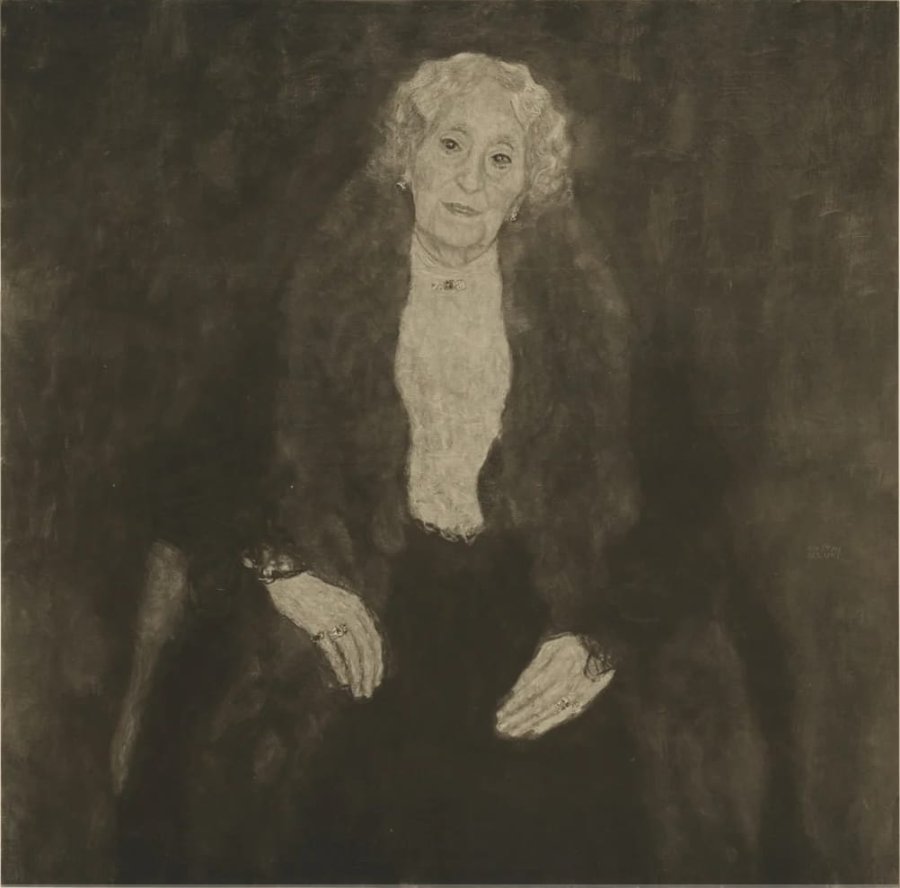
Amazingly, Klimt also painted a third generation of the family: Serena’s mother and Elisabeth’s grandmother, Charlotte Pulitzer, who was the grandniece of newspaper publisher Joseph Pulitzer. (And to show you just how much Klimt was still dependent on the Lederers even as a well-known and well-respected artist, when finishing her mother’s portrait, he wrote to Serena asking for advance on “the meager rest of the fee,” adding “I am waiting for it like the devil—for a poor soul!”)
Sadly, the whereabouts of the painting are unknown. In 1940, the Nazis confiscated the Lederer’s art collection and transferred a lot of it to the Schloss Immendorf castle in Lower Austria. In 1945, a fired burned down the castle, and it’s believed that as many as 10 Klimt works – possibly including the portrait of Charlotte – were destroyed. This photograph is all the remains:
Black and white photograph of a painting of an elderly seated woman with curly light hair, a dark fur wrap, rings on her hands, and a dark background
Gustav Klimt, Charlotte Pulitzer's lost portrait
Source: news.artnet.com
A whole family painted, and one portrait lost to fire. Does that change how you see the work?
Tap one and the reply writes itself.
Yes, completely
A little
I see the art first

Klimt’s Dubious Reputation Helped Dupe the Nazis

August Lederer died in 1936, and when the Nazis took over control of Austria a couple of years later, Serena – who was from a Jewish family – left for Hungary. Elisabeth decided to stay, however. After marrying the exceptionally-named Wolfgang von Bachofen-Echt in 1921, she converted to Protestantism. However, they divorced in 1938, which made Elisabeth suspectable to persecution.
This is when Elisabeth had an inspired idea: To mask her Jewish heritage, she’d claim to be Klimt’s illegitimate daughter. It was widely known that the artist dipped his brush into a lot of palettes, so to speak, and there were claims that he had as many as 14 children with several different women.
To protect her daughter, Serena went along with the story, and she even swore under oath that it was true. The Reich Department for Genealogical Research believed it, and while Elisabeth didn’t survive the war, the lie did offer somewhat of a safeguard from the terror of the Nazis.
Painting of a young woman with short dark hair in a sheer patterned robe, standing before blue dragons, flowers, and small figures, on an orange rug
Gustav Klimt, Elisabeth Lederer again
Source: news.artnet.com
One final note about Klimt’s portrait of Elisabeth. He was paid 35,000 Austro-Hungarian crowns for the work – about $4,400 in U.S. currency – equivalent to around $135,000 today. While a nice payday, the work recently set a record as the most expensive modern art piece ever sold at auction, raking in $236.4 million. Not too bad for a poor soul.
Which of his paintings stayed with you?
Tap the closest one, or hit reply and tell us in your own words. We read every note.
The golden couple
The woman in white
The dragon robe
The lost grandmother
Art Snob
How was this issue?
One tap is all it takes.
Bad
Pretty good
Too snobby
Get the next issue
Got a friend who owns a print of dogs playing poker and is not ashamed of it? Forward this issue to them.

Keep Reading

Read More

Home

Archive

Terms of Use

Privacy Policy

2026 Art Snob. All rights reserved.