Logo
Home
Archive
Log in
Get the next issue
Logo
  • Home
  • Posts
  • An American Impressionist’s Long-Lost Mural
6 NOVEMBER 2026

An American Impressionist’s Long-Lost Mural

 
There are few World’s Fairs as famous as the one that took place in Chicago in 1893. The massive “White City” was constructed on nearly 700 acres, and more than 27 million people attended. The fair introduced several never-before-seen things, like the zipper and Ferris Wheel, and even the brownie. It was also where notorious serial killer H. H. Holmes stalked a lot of his prey.
One of the true highlights of the fair was all of the art displayed, and this included paintings from James McNeill Whistler, Winslow Homer, John Singer Sargent, and many others. While primarily a boys’ club, there was actually an entire building devoted to exhibiting the art of women. But sadly, the biggest contribution from the most prominent female painter at the time has now been lost to history.
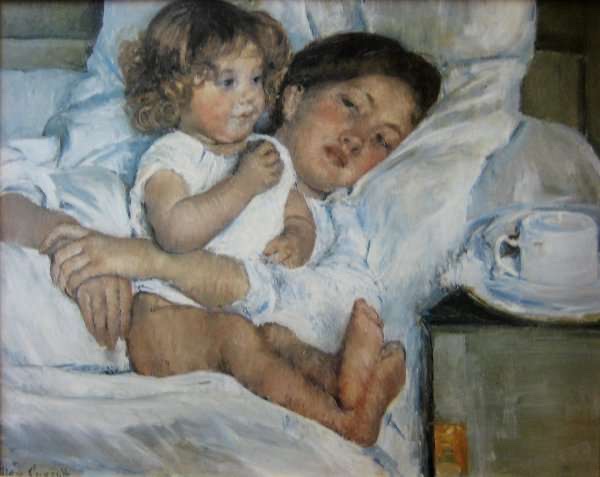
Painting of a curly-haired toddler in a white shift sitting against a woman resting in bed, with white sheets, pillows and a teacup nearby
Breakfast in Bed, 1897
Source: marycassatt.org
While Mary Cassatt is now mostly known for her charming mother and child paintings like the one above, she didn’t adopt this style until later in her career. Before that, she was considered an Impressionist. And although an American, she was welcomed to join that exclusive group in France, and she regularly hobnobbed with the masters, such as Monet, Renoir, and Degas.
In 1892, Cassatt was asked to create a mural for the Woman’s Building at the World’s Fair. This was for the north tympanum over the entrance to the Gallery of Honor and would involve a huge space about 14 feet high and 60 feet long. But before she agreed, she had to get past her own reservations – along with some pointed words from a friend and colleague.

Handed Over to Destruction?

Large-scale public commissions like the one offered to Cassatt were rare, especially for women. Even so, she was hesitant, as this would involve a lot of work and wasn’t in her comfort zone. In a letter to friend Louisine Havemeyer, she said she was “horrified” about being asked to paint the mural.
One person who was adamant that she reject the idea was her buddy Degas. He and his Impressionist cronies believed that public works didn’t exactly jibe with their art. There also seemed to be more than a tinge of sexism with his criticism. In a letter to Camille Pissarro in June of 1892, Cassatt wrote: “You ought to hear Degas on the subject of a woman’s undertaking to do such a thing, he has handed me over to destruction.”
It was perhaps because Degas protested so much that Cassatt was eventually convinced to say yes. In that same letter to Havemeyer, Cassatt said “gradually I began to think it would be great fun to do something I had never done before and as the bare idea of such a thing put Degas into a rage and he did not spare every criticism he could think of, I got my spirit up and said I would not give up the idea for anything.”
Degas raged, and that is what made her say yes. Would that work on you?
Tap one and the reply writes itself.
Ha, absolutely
Maybe a little
Never, I decide alone
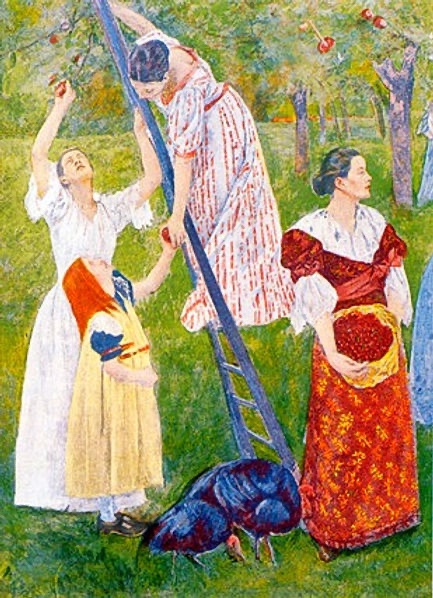
Painting of women in an orchard picking apples, one on a blue ladder, with a girl in yellow, a woman in red holding fruit, and dark turkeys in the grass
Modern Woman, c. 1893, colored photograph of the mural
Source: dailyartmagazine.com

A Celebration of Women

Cassatt worked tirelessly on the mural for most of the latter part of 1892, and it took her nine months to complete. Eventually entitled Modern Woman, she created it at her studio in France and shipped off the huge canvases to Chicago when it was done.
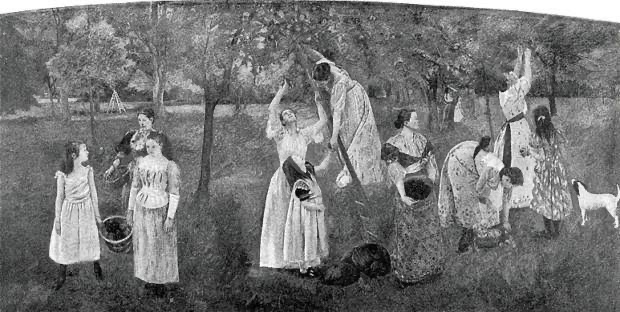
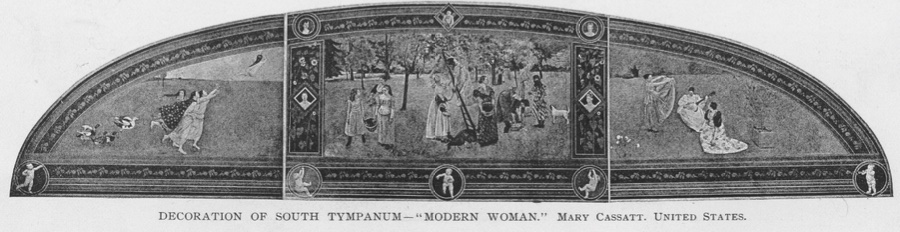
The work is meant to show the evolution of women and their roles. There is a distinct – and purposeful – biblical feel to the painting, particularly with the central panel featuring women picking apples. It also evokes feminism, pretty radical at the time, with women engaged in art, music, and science. In addition, it shows women passing their knowledge to younger generations.
“It was Cassatt really scaling up her subject matter, what she had built her career portraying, the lives of everyday women, but giving that a sense of import, a sense of grandeur,” says Annelise Madsen of the Art Institute of Chicago.
Above all, the mural is intended to be a celebration of women, which is why Cassatt chose vibrant colors. She called the occasion depicted “one of rejoicing, a great national fête,” and said she “reserved all the seriousness for the execution, for the drawing & painting.” 
Black and white photograph of a wide mural showing women and girls in an orchard picking fruit, with a basket, a bending figure and a small dog at right
Modern Woman, c. 1893
Source: dailyartmagazine.com

A Luke-Warm Public Reception and Then…Gone

When the World’s Fair officially opened and people were able to view Modern Woman, many visitors didn’t know what to make of the ahead-of-its-time mural. Because it was new and different, it was unlike anything they may have ever seen before. Some viewers thought the bold colors were shocking, and others didn’t like the subject matter. One journalist called it “impudent” and “brutal.”
Fast-forward over 100 years, and now the work is considered groundbreaking. It is, however, no longer in existence. After the fair ended on Halloween of 1893, the mural was put into storage in the Palace of Fine Arts, which is now the Museum of Science and Industry. After that, nobody knows what happened to it. Fortunately, thanks to the work of curators at the Art Institute, a new exhibit aims to recreate the mural, if not in its exact form, with at least its original spirit.
Black and white photograph of an arched decorative panel with a central orchard scene, side scenes of dancing and music, a patterned border and small cherub medallions
Modern Woman, c. 1893
Source: dailyartmagazine.com
Which of her paintings stayed with you?
Tap the closest one, or hit reply and tell us in your own words. We read every note.
The breakfast in bed
The apple pickers
The whole orchard
The arched panel
Art Snob
How was this issue?
One tap is all it takes.
Bad
Pretty good
Too snobby
Get the next issue
Got a friend who owns a print of dogs playing poker and is not ashamed of it? Forward this issue to them.

Keep Reading

Read More

Home

Archive

Terms of Use

Privacy Policy

2026 Art Snob. All rights reserved.