Logo
Home
Archive
Log in
Get the next issue
Logo
  • Home
  • Posts
  • From Nazi Germany to Flower Power: The Life and Times of Peter Max
12 OCTOBER 2026

From Nazi Germany to Flower Power: The Life and Times of Peter Max

 
When you think of America in the late 1960s, what springs to mind? Maybe protests or sit-ins. Possibly newsreel footage of soldiers in a jungle. Perhaps long-haired folks grooving out at a concert. If you’re also envisioning flowers or the cosmos or landscapes in vibrant yellows, reds, and oranges, you’re almost certainly thinking of the work of Peter Max, who died in September at the age of 88.
It was Max who helped popularize the psychedelic art that the time period is known for. And while he embraced the hippie scene and its mantra of peace, it wasn’t always easy for Max to find peace in his own life, both personally and professionally.
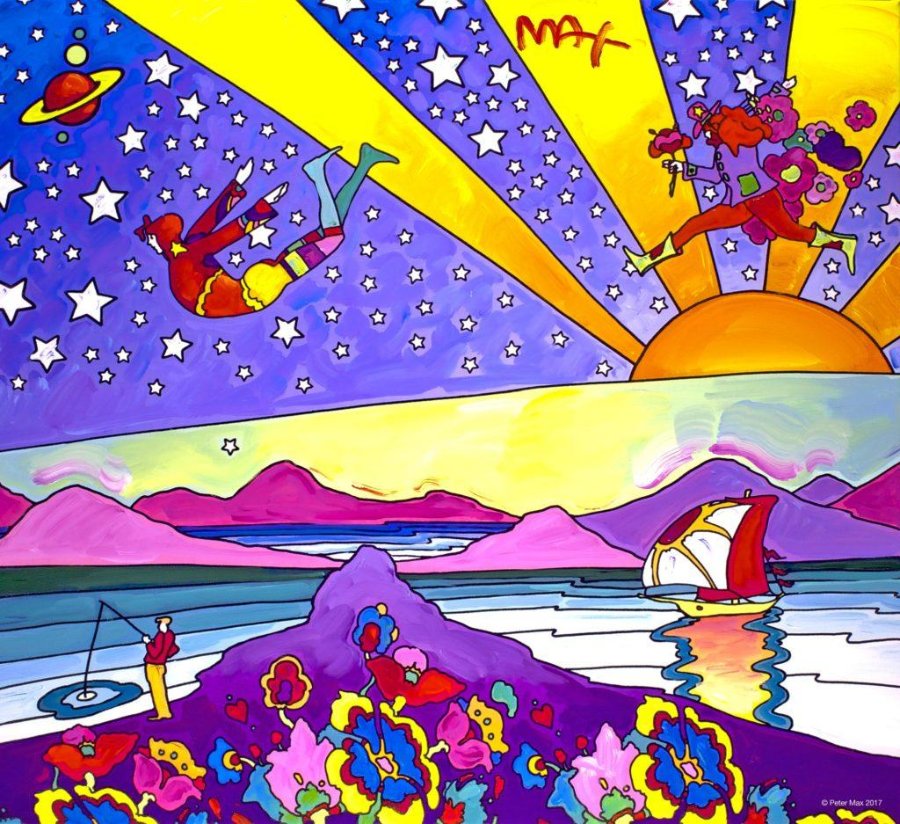
Painting of a falling figure and a running figure among white stars, with a sailboat, a fisherman, purple mountains, a large orange sun and bright flowers, in purple, yellow and pink
Peter Max, a cosmic landscape at sunrise
Source: oceangalleries.com
Good vibes were certainly in short supply when Max came into the world in 1937. Born Peter Max Finkelstein, his Jewish family lived in the worst possible place at the worst possible time: Berlin, Germany. Fortunately, they were able to get out, and Max spent much of his childhood in Shanghai, China, which is where he began creating art. After stops in Israel and Paris, the family settled in New York City, and it was there that Max attended different art schools, including Pratt Institute.

Skyrocketing But Ultimately Unsatisfying Success

In 1961, Max and some friends opened their own graphic design studio. It didn’t take long before his unique art was in high demand from ad agencies and various publications. He was even hired to create covers for Manhattan phone books. Soon his colorful images sprouted up seemingly everywhere. “It was on mugs, it was on bedsheets, it was on dresses, it was on silks and scarves and ties — 70 product lines,” he said.
Posters of his work were especially prevalent on the walls of dorm rooms, as it really resonated with young people. In 1967, Max created artwork to promote New York’s second “Be In,” a gathering of thousands of hippies in Central Park.
Along with his art, Max himself was becoming famous. He appeared on both the Tonight Show with Johnny Carson and the Ed Sullivan Show. In 1969, he was featured on the cover of Life Magazine. He became friends with many celebrities, including the Beatles.
[Fun fact: Although the album cover for “Yellow Submarine” is often attributed to Max, as it resembles his cartoonish imagery, it was actually designed by illustrator Heinz Edelmann.]
While he was a success commercially, Max wasn’t happy. He thought his art was being exploited, and worse, he was bothered because he was no longer painting. This is why he made the decision in the early 70s to shut down his business.
Fame, 70 product lines, and he still felt unhappy. Did that surprise you?
Tap one and the reply writes itself.
Not really
A little
Yes, a lot
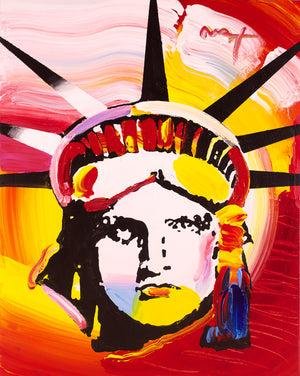
Painting of the Statue of Liberty's face and black spiked crown against swirling red, orange, yellow and pink brushstrokes
Peter Max, the Statue of Liberty's face
Source: petermax.com

Lady Liberty Brings Him Back – and He Helps Brings Her Back

In 1976, American commemorated its 200th anniversary. To celebrate the occasion. Max started making paintings of the Statue of Liberty. At the invitation of First Lady Nancy Reagan in 1981, he visited the White House to create a series of portraits of Lady Liberty.
When he got back to New York, a friend told him about the terrible state of the statue and how badly it needed repair. One of the people trying to raise money for the project was Lee Iacocca, chairman of Chrysler. Max reached out to him and soon they were working together, and through their efforts, more than $350 million was collected for the required renovations.

Late-Life Controversies

Although wealthy and famous, controversy followed Max later in life. He pleaded guilty to tax fraud in 1997, as the IRS claimed he concealed over $1 million in income from his art. Originally sentenced to two months in prison, he was instead able to serve the time in a work-release program. He was also ordered to pay back the money along with a fine, and perform community service as an art teacher in schools in Harlem.
This wasn’t the only time the Max name appeared in court documents. In 2015, Mary Max, his second wife, got into a legal dispute with Peter’s estranged son Adam from his first marriage. By this time, the artist had developed dementia, and Adam contended that Mary was squandering his money and mistreating him. She in turn said that Peter was being kept from him against his will and that paintings belonging to her had been stolen.
In 2019, the New York Times published an article chronicling the legal issues surrounding Peter Max, including allegations that although he was unable to paint, his studio – which was being managed in part by Adam – was still mass-producing his work and that his signature was being forged. Two weeks after the article came out, Mary Max committed suicide.
Legal fights and forged signatures came late in life. Does it change how you see his art?
Tap one and the reply writes itself.
Not at all
A little
Yes, completely
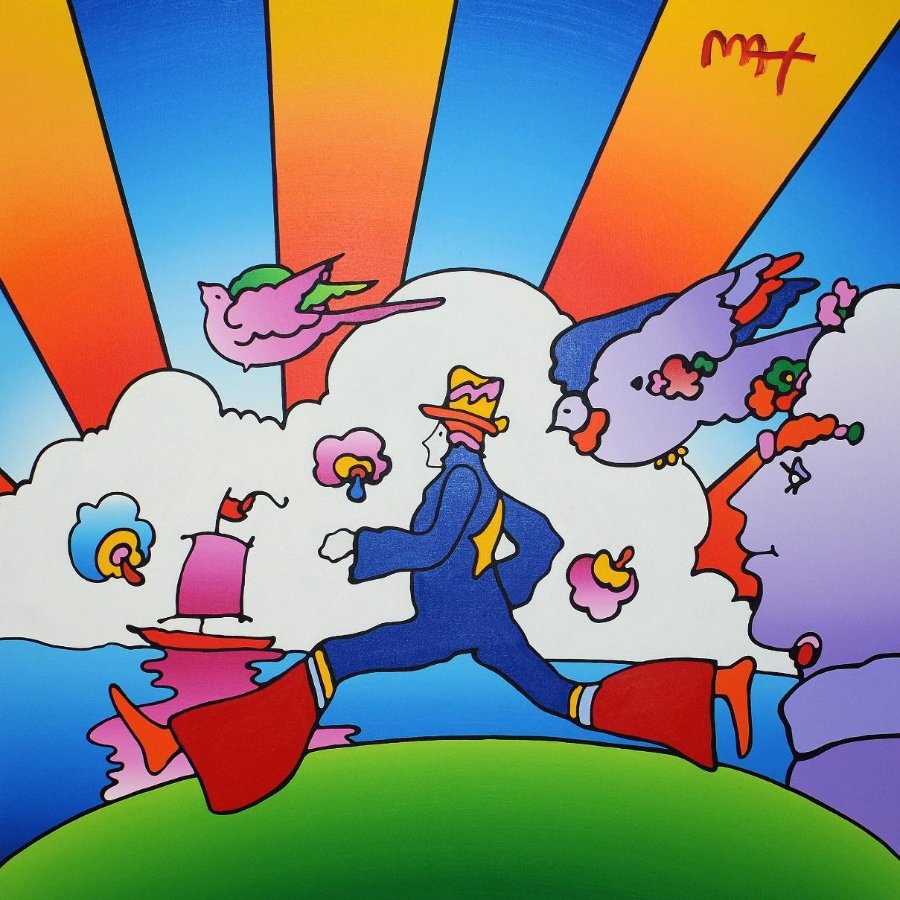
Painting of a man in a blue suit and tall yellow hat striding over a green hill, with pink and purple birds, white clouds, a sailboat and orange and blue rays
Peter Max, a man running past clouds
Source: artsmanagementmagazine.com

‘Rainbow Eyes’

While it’s easy to focus on the tawdriness of the latter issues that affected Peter Max, it’s his art that he should best be known for. Throughout his decades of work, he has painted presidents and pop stars (including Taylor Swift). He’s been the official artist for events like the Olympics, World Cup, and Super Bowl. His art has appeared on airplanes and cruise ships. Why is his work so beloved? Because it’s happy and joyful.
“The colors are strong, sometimes loud, sometimes raw and sometimes harmonious, but always powerful, and the images are always on the side of the peaceful nature,” he said. “I don’t discuss in my paintings negative things, I don’t dwell on it in my mind and don’t dwell on it in my canvasses.”
His signature philosophy says it all: “I see everything through rainbow eyes.”
Which of his paintings stayed with you?
Tap the closest one, or hit reply and tell us in your own words. We read every note.
The cosmic landscape
The Liberty head
The runner in the clouds
Something else
Art Snob
How was this issue?
One tap is all it takes.
Bad
Pretty good
Too snobby
Get the next issue
Got a friend who owns a print of dogs playing poker and is not ashamed of it? Forward this issue to them.

Keep Reading

Read More

Home

Archive

Terms of Use

Privacy Policy

2026 Art Snob. All rights reserved.