Logo
Home
Archive
Log in
Get the next issue
Logo
  • Home
  • Posts
  • Lee Krasner: Not Just the Woman in Pollock’s Shadow
21 OCTOBER 2026

Lee Krasner: Not Just the Woman in Pollock’s Shadow

 
Surely you’ve heard the expression about a great man having a great woman behind him. And while in many situations this is true, the problem is that often while the man receives accolades for being great, the woman doesn’t get the recognition she deserves and kind of fades into the background.
There are many examples of this in the art world, such as Diego Rivera and Frida Kahlo. For decades, he was the one who got the acclaim, and it wasn’t revealed until much later how much of an impact she had on him and his work. (Things seem to have changed these days, and now she’s by far the more popular of the two.)
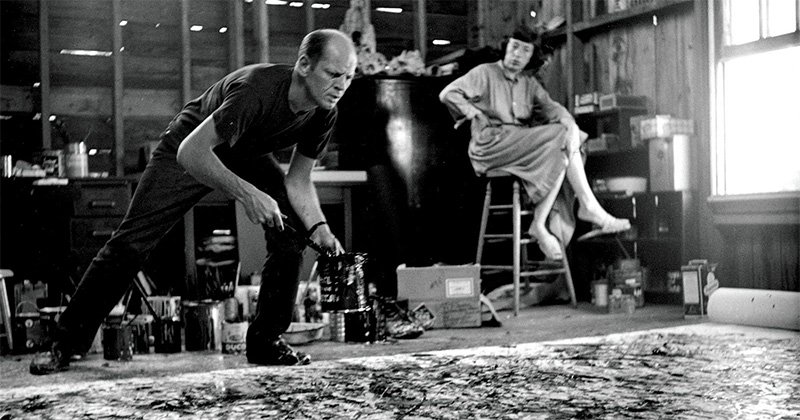
Most people know Jackson Pollock, if not by name, by his drip paintings that turned him into an art star. Most people, however, don’t know the woman behind the man and the role she played in his life, along with the fact that she herself was a renowned artist.
Black and white photograph of a man leaning over a paint-splattered floor canvas holding a paint can, while a woman sits on a ladder stool behind him in a wooden studio
Jackson Pollock and Lee Krasner
Source: jewishberkshires.org

The Right Time and Place

Lee Krasner (originally Lena) was born in 1908 to Orthodox Jewish parents who had settled in Brooklyn after leaving Russia. While her family knew little about art, this is what Krasner wanted to study, and she attended the Women’s Art School at Cooper Union and the National Academy of Design. She also went to the Hans Hofmann School of Fine Arts where Hofman himself – attempting a compliment – said her work was “so good you would not know it was painted by a woman.”
During the Depression, she painted murals for the Works Progress Administration, and in 1937, joined the American Abstract Artists group. The art scene in New York at this time was bubbling, and Krasner seemed to know everybody in it, including Piet Mondrian and John D. Graham.
In 1942, Graham put on an exhibition of French and American Painting at an antique furniture store in New York, and Krasner was included. So too was Jackson Pollock, and it was this meeting that changed things forever for both of them. Three years later, they were married.
Two artists met at one small show and married three years later. Fate or good timing?
Tap one and the reply writes itself.
Pure fate
Good timing
Hard work, honestly
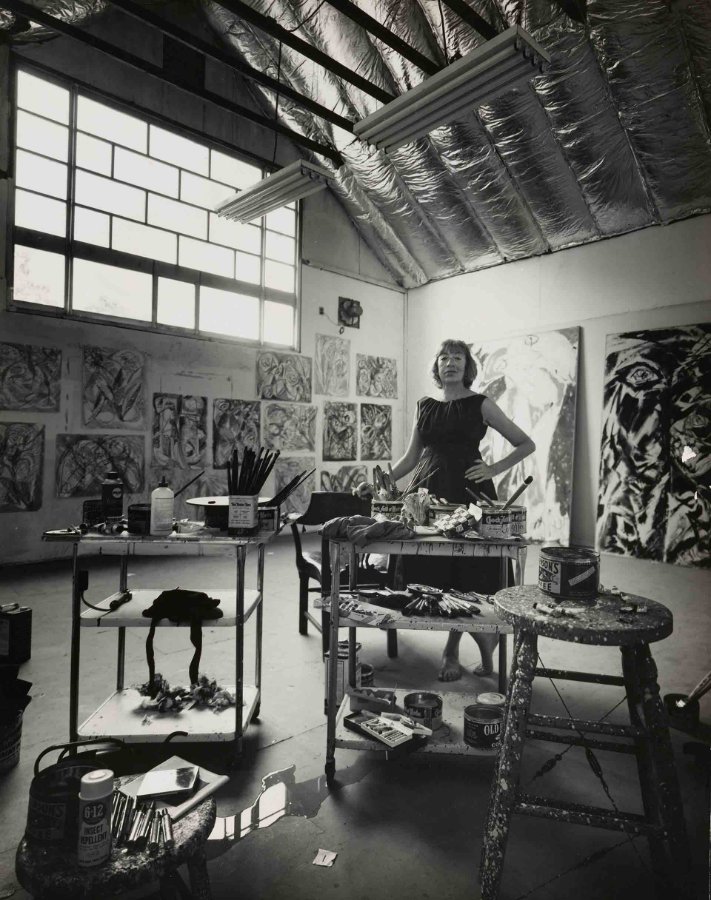
Photograph of a woman standing with hands on her hips in a large studio with tall windows, paint carts, brushes and big drawings on the walls
Lee Krasner in her studio in the barn, Springs, 1962. Image taken by Hans Namuth. Center for Creative Photography / The University of Arizona, The Hans Namuth Archive.
Source: guggenheim-bilbao.eus

Not So Happily Ever After

Despite his artistic talents, Pollock wasn’t exactly the greatest person in the world, and he was known for being moody and violent. He also suffered from depression and was an alcoholic. After they married, Krasner made a calculated choice. Although Pollock died young at age 44, without her, it’s quite possible he wouldn’t have even made it that long. She decided they should move out to Springs, NY, on the far end of Long Island to get him away from the temptations of Manhattan.
For a time, things were idyllic and peaceful. The two spent time riding bikes, digging for clams, and of course, painting. He worked in a barn on the property, while she painted in the kitchen or an upstairs bedroom. While she became an ardent supporter and champion of his work, she was also developing in her own right as an artist. In a 1978 interview she was asked about Pollock’s skyrocketing success and how she was seen as kind of an assistant – if she was seen at all.
“I was working all the time,” she replied. “I doubt our relationship could have existed at all if I weren't working. In terms of what other people think, I can't do anything about that. You know, that's not my preoccupation anyway. As long as I was able to work, I went about my business.”
It was during this period that Krasner started creating mosaiced tabletops and her Little Images series – tiny canvases filled with dense images and symbols that resembled hieroglyphics. She also began experimenting with collage, and she often used Pollack’s discarded works to create them.
“Collage was very catalytic for her at these crucial moments in her life,” said Brinda Kumar, a curator at the Metropolitan Museum of Art. “She was literally sometimes tearing up older bodies of work to create a new chapter.”
Painting of overlapping torn paper shapes in cream, brown, peach and black with splatters, set over bright orange and pink, with one small yellow sliver at left
Lee Krasner, Bald Eagle, 1955, Oil, paper, and canvas collage on linen, ASOM Collection
2026 Pollock-Krasner Foundation/Artists Rights Society (ARS), New York
Source: npr.org

Emerging from His Shadow

She moved to a quiet town to keep him safe. Was that love or strategy?
Tap one and the reply writes itself.
Love
Both
Strategy, clearly
In August of 1956, Pollock died in a car accident not far from the couple’s home. He was driving drunk and crashed into some trees. Another passenger was killed, and Pollock’s lover (who was also in the car) was severely injured. Krasner was in Europe at the time. A year after his death, she moved into the barn studio and her work began to change. For one thing, it got a lot bigger.
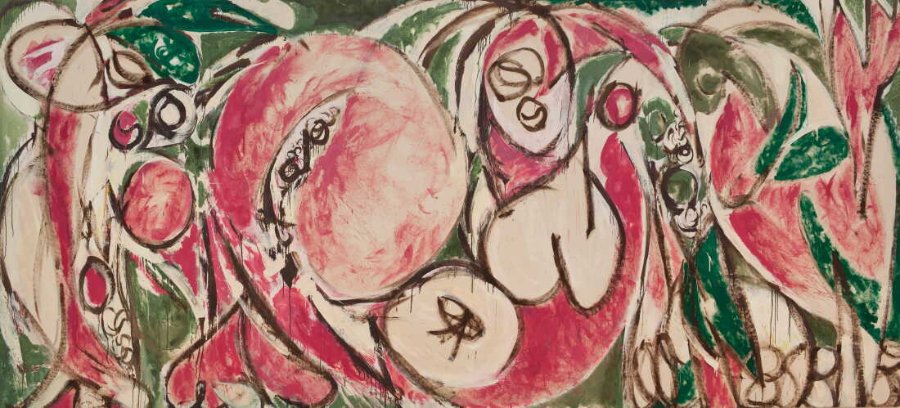
“You see this incredible painting that's almost 17 feet wide called The Seasons, that has these forms and bodies, eyes and body parts and these things that look like vegetation sprawling out of it,” curator Breslin said. “So she makes, almost in a contradictory way, some of the brightest, most vibrant paintings the year after his death.”
Wide painting of rounded, sprawling forms with eyes and leaf shapes in pink, red, green and cream, outlined with loose dark brown lines
Lee Krasner, The Seasons, 1957, Oil and house paint on canvas, Whitney Museum of American Art
The Pollock-Krasner Foundation/Artists Rights Society (ARS), New York
Source: npr.org
Krasner, unlike Pollock, also continually experimented with her art and wasn’t afraid to reinvent her style. Said Mary Gabriel, who has written about her: “Krasner was so fascinating because she changed, not even by the decade. Every few years, she tries something new. She was always searching, which in a way is the most, I think, honest way to be an artist, because art is about discovery.”
At the same time, Krasner recognized her responsibility to Pollock and his legacy, not to mention his estate. A savvy business woman, she more than tripled the price of his Autumn Rhythm (Number 30), to sell it to the Met after he died. This didn’t just set the market value for his work, but helped the earnings of other artists as well.
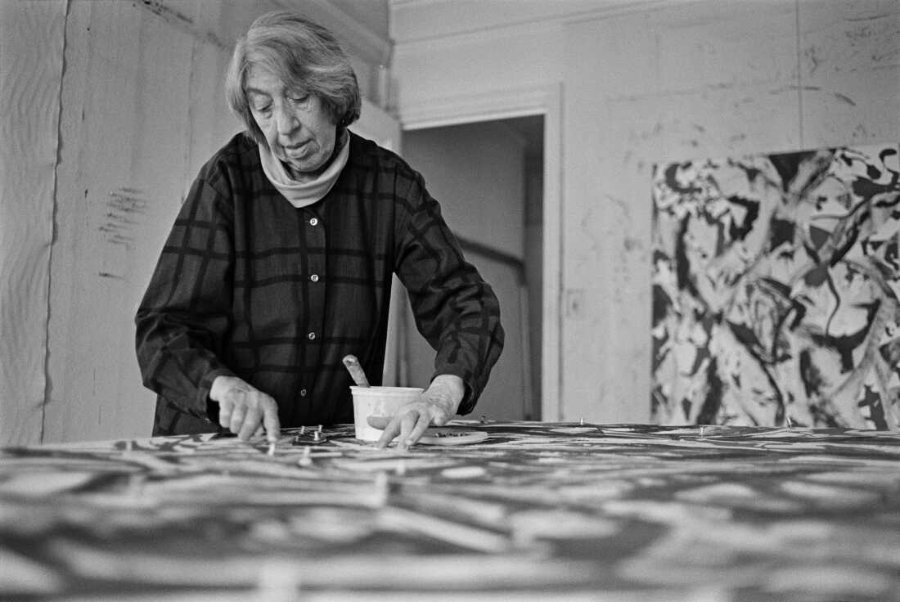
Krasner died at the ripe age of 84, making it a full 40 years longer than her husband. She also continued to work well into her 70s. While Pollock’s light may have burned brighter, it’s pretty clear that it also burned out a lot faster.
Photograph of Lee Krasner at work in her studio in 1981
Krasner at work in 1981.
Ernst Haas/Getty Images
Source: npr.org
Which of her works stayed with you, the collages, paintings or photos?
Tap the closest one, or hit reply and tell us in your own words. We read every note.
The couple in the studio
The woman in the barn
The torn paper collage
The giant Seasons canvas
Art Snob
How was this issue?
One tap is all it takes.
Bad
Pretty good
Too snobby
Get the next issue
Got a friend who owns a print of dogs playing poker and is not ashamed of it? Forward this issue to them.

Keep Reading

Read More

Home

Archive

Terms of Use

Privacy Policy

2026 Art Snob. All rights reserved.